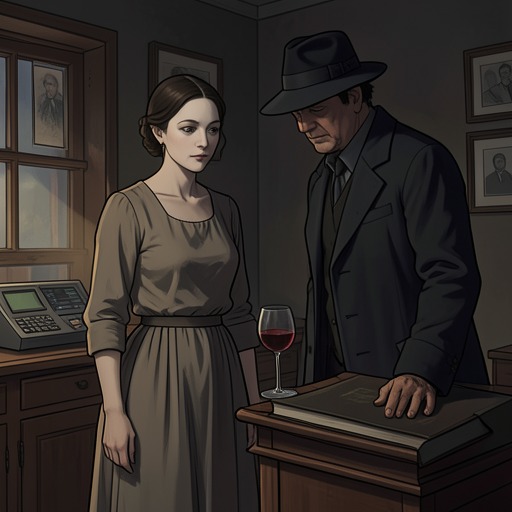
Anselmo's death
Don QuixoteAnselmo’s death closes the tragedy set in motion by his attempt to test Camilla’s fidelity: when the danger of exposure becomes immediate, the experimenter discovers too late that his own design has destroyed the life he meant to scrutinize. His end is not a sudden external punishment but the final consequence of a sequence of departures, revelations, and mistaken conclusions, and even his last written words stop before he can finish explaining himself.
Causes and Flight
Camilla’s flight begins when Anselmo tells her that Leonela has promised to disclose matters of serious importance. Camilla fears that Leonela will reveal her unfaithfulness and decides not to wait to learn whether that fear is justified. During the night, believing Anselmo asleep, she gathers her most valuable jewels and some money, leaves the house unseen, and goes to Lothario. She asks him either to find her a safe place or to flee with her. The crisis leaves Lothario unable to answer at first; he eventually takes her to a convent where his sister is prioress. Camilla agrees to stay there, while Lothario leaves the city without telling anyone where he is going.
Discovery and Misrecognition
At daylight, Anselmo goes to the room where he had locked Leonela, expecting to hear what she had promised to tell him. The room is empty. Sheets knotted to the window show that she escaped by lowering herself from it. He returns to look for Camilla and finds that she, too, is gone. His servants can offer no explanation, but the open boxes and missing jewels disclose that Camilla has left with more than a momentary intention to hide. Anselmo realizes that Leonela was not the cause of his misfortune; the absence of his wife is the evidence that his confidence in her virtue can no longer protect him from the consequences of his own experiment.
He goes at once to Lothario’s house. There, the servants report that Lothario was away all night and took all his money. Returning to his own home, Anselmo finds it deserted, with none of the household servants remaining. He understands himself to have been left without wife, friend, or household, and to have lost his honour along with the life he thought he knew. The narrative makes each discovery cumulative: Leonela’s escape first raises the alarm, Camilla’s departure identifies the personal loss, and Lothario’s absence turns suspicion into a sense of complete abandonment.
The Report on the Road
Anselmo locks his house, mounts his horse, and sets out for the village of the friend with whom he had been staying when he created the circumstances of his calamity. Before he has gone halfway, however, his reflections force him to dismount and tie the horse to a tree. He remains there until nearly nightfall, then asks a passing rider for news from Florence. The citizen describes a report circulating in the city: Lothario supposedly carried Camilla off, and both Lothario and Anselmo have disappeared. The story, attributed to a maidservant found escaping from Anselmo’s house, has made the city wonder at the scandal because the two men had been known as intimate friends, called “The Two Friends.”
Anselmo asks which road the pair took, but the citizen knows nothing further; the governor is searching for them. The report is not the full account the reader has just witnessed. Lothario did take Camilla away from the house, but he brought her to his sister’s convent and then departed alone. Anselmo, hearing only the public version, receives a distorted account at precisely the moment when he can no longer bear uncertainty. The gap between what happened and what is reported sharpens the tragedy: the rumor offers no path toward recovery, only a final confirmation, to Anselmo, that he has lost everything.
The Unfinished Declaration
The news nearly robs Anselmo of both life and reason. He reaches his friend’s house pale and worn, asks to rest, and requests writing materials. Wanting to be alone, he has the door locked. He believes the signs within him show that death is near and begins a written declaration explaining the cause of his end. Before he can complete it, his breath fails and he dies, a victim of the suffering caused by his ill-advised curiosity.
The master of the house eventually enters when Anselmo does not call. He finds him partly on the bed and partly on the writing table, with the paper open and the pen still in his hand. The physical arrangement leaves his intended explanation present but unfinished. His surviving words call his desire foolish and ill-advised, forgive Camilla, and concede that she was not bound to perform miracles or that he should have demanded them. He begins to acknowledge himself as the author of his dishonour, but the sentence breaks off before the thought is complete. The confession therefore names the central cause of the disaster without giving Anselmo the chance to control its full account.
Aftermath and Significance
The next day, Anselmo’s friend informs his relatives and the convent where Camilla is staying. She is already close to death, not because she has heard of her husband’s passing, but because she has learned that Lothario has gone away. Though widowed, she initially refuses both to leave the convent and to take the veil. Later she learns that Lothario has been killed in a battle in the kingdom of Naples, where he had gone after leaving her. Camilla then takes the veil and dies not long afterward, exhausted by grief and melancholy. Anselmo, Camilla, and Lothario thus all die, and the tale links their endings to what began as a thoughtless experiment.
The curate, who has read the embedded tale, accepts the quality of its telling but doubts its plausibility: he finds it difficult to believe that a husband would undertake so costly a test. That response frames Anselmo’s death as both the emotional culmination of the tale and the consequence of a premise the reader is invited to question. Within the story, Anselmo’s final recognition comes too late to repair the harm; in the surrounding conversation, the curate’s skepticism keeps the tragedy from being treated as an uncomplicated account of believable conduct.